
Design Apartment Styria: Five Apartments, No Pattern
A design apartment in Styria doesn't have to come out of a furniture catalogue. At Johann & Anna in Stainz, five apartments share one roof - but no two of them look alike.
Search for "design apartment Styria" and most results show the same thing: a bright room, a grey sofa, a concrete wall, a photo that could just as easily have been taken in Berlin or Hamburg. At Johann & Anna in Stainz, it looks different, for a simple reason: the five apartments in the house weren't styled to a single concept - they were furnished individually, with furniture gathered over years, with wooden beams that were already there before the renovation, and with floor plans shaped by the rooms themselves rather than by a template. The result isn't one consistent look but five apartments with five different answers to the same question: how do you live here for a few days.
What "Design" Actually Means for an Apartment
In the accommodation industry, the word is often used to sell a particular image: exposed concrete, black fittings, a lounge chair that looks like it was just unwrapped. That's a style, not a statement about the apartment itself. Design in its actual sense means something else: that someone made a decision about why a room looks the way it does - and that the decision fits the building, not a trend.
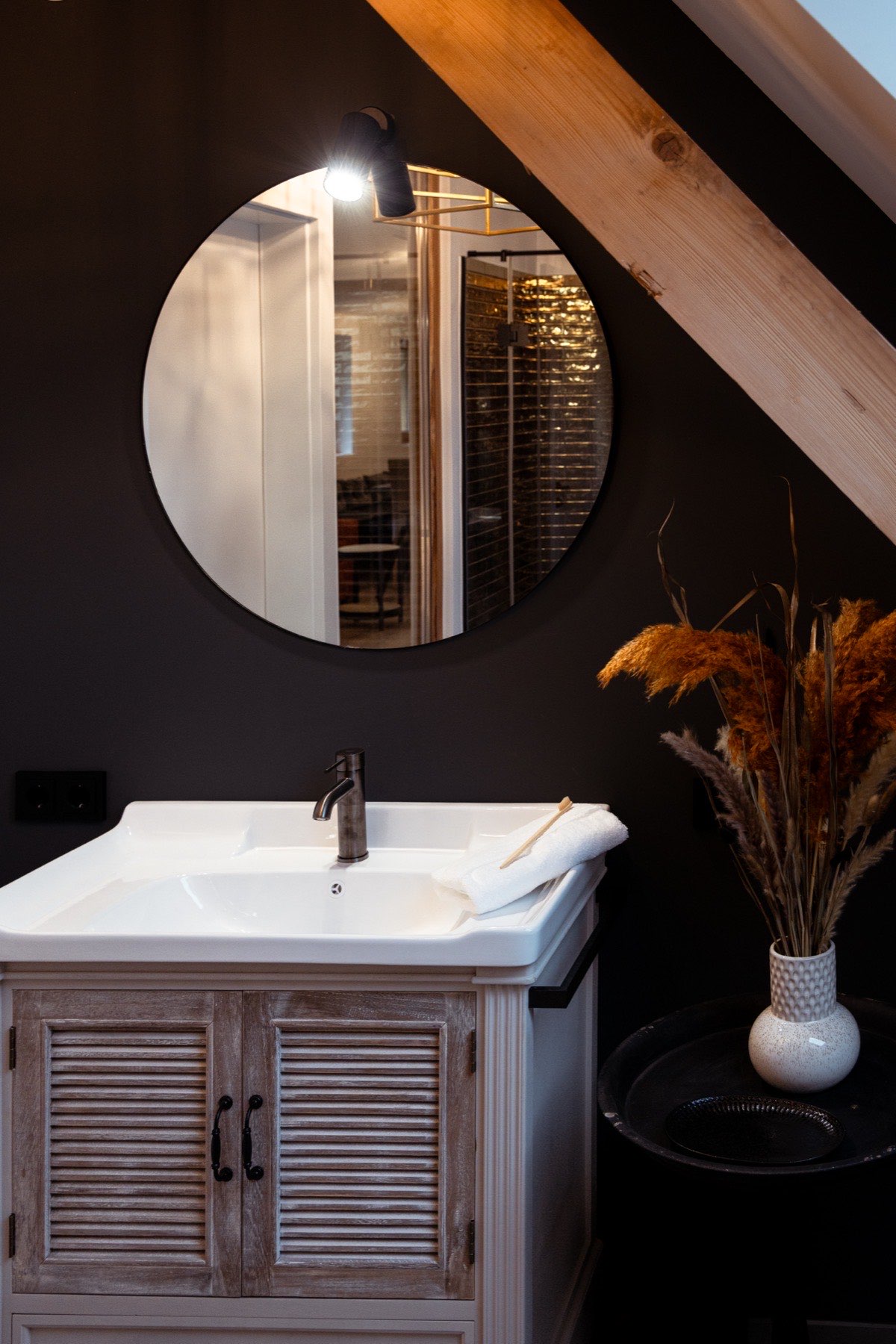
At the estate on the Stainzbach, this shows up in very specific places. The wooden ceiling beams weren't boxed in but exposed and left visible, irregularities and all, the kind a hundred-year-old timber frame carries with it. The floors differ from apartment to apartment - floorboards here, tiles there, depending on what each room originally had and what could reasonably be kept. And the furniture doesn't come from a single order: an inherited wardrobe next to a new bed, an old side table next to a current reading lamp. None of it was put together to look good in a photo. It was put together so people could live in it.
Design Apartment Styria: Old Wood, New Use
The wooden beams in the attic weren't replaced during the renovation, they were exposed. Cracks and variations in the wood's colour remained part of the room - a detail that can't be recreated, because it comes from the building's actual construction history, not from a design concept.
Why None of the Five Apartments Look Alike
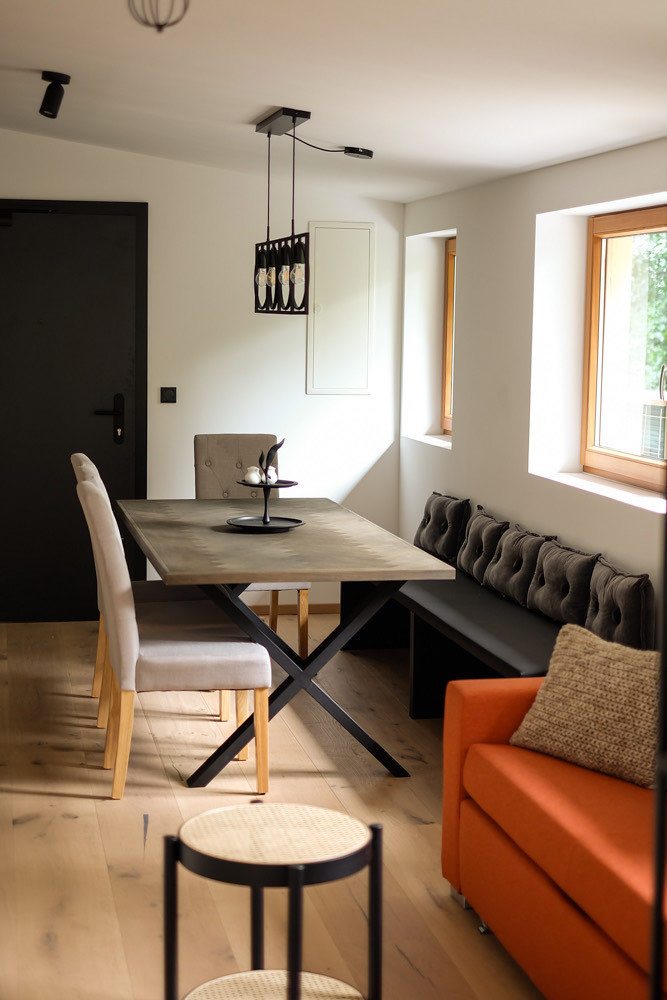
A design apartment in Styria worth taking seriously should really be the opposite of repetition - and that was the starting point at Johann & Anna. Furnishing five apartments in one building identically would have been the easier route: one supplier, one furniture plan, the same sofa five times over. Instead, each apartment got its own name, its own floor plan, and its own choice of materials. Johann sits in the oldest part of the house and carries the most visible historical details accordingly - thick walls, a dedicated work area, dark wood. Anna is furnished in lighter tones, with more open space and quieter colours. Steiermark has two bedrooms and bolder materials, built for groups who need more room. Fuchs is the most compact of the five apartments, with warm wood tones that make the smaller floor plan feel focused rather than cramped. Kaiserblick, in turn, is built around the view, with furnishings restrained enough not to compete with it.
Stay in all five, one after another - some guests come back repeatedly and deliberately choose a different apartment each time - and you notice there's no ranking in which one counts as "the nicest." There are only different answers to the same starting point.
Design Apartment Styria: The Johann Apartment in Daylight
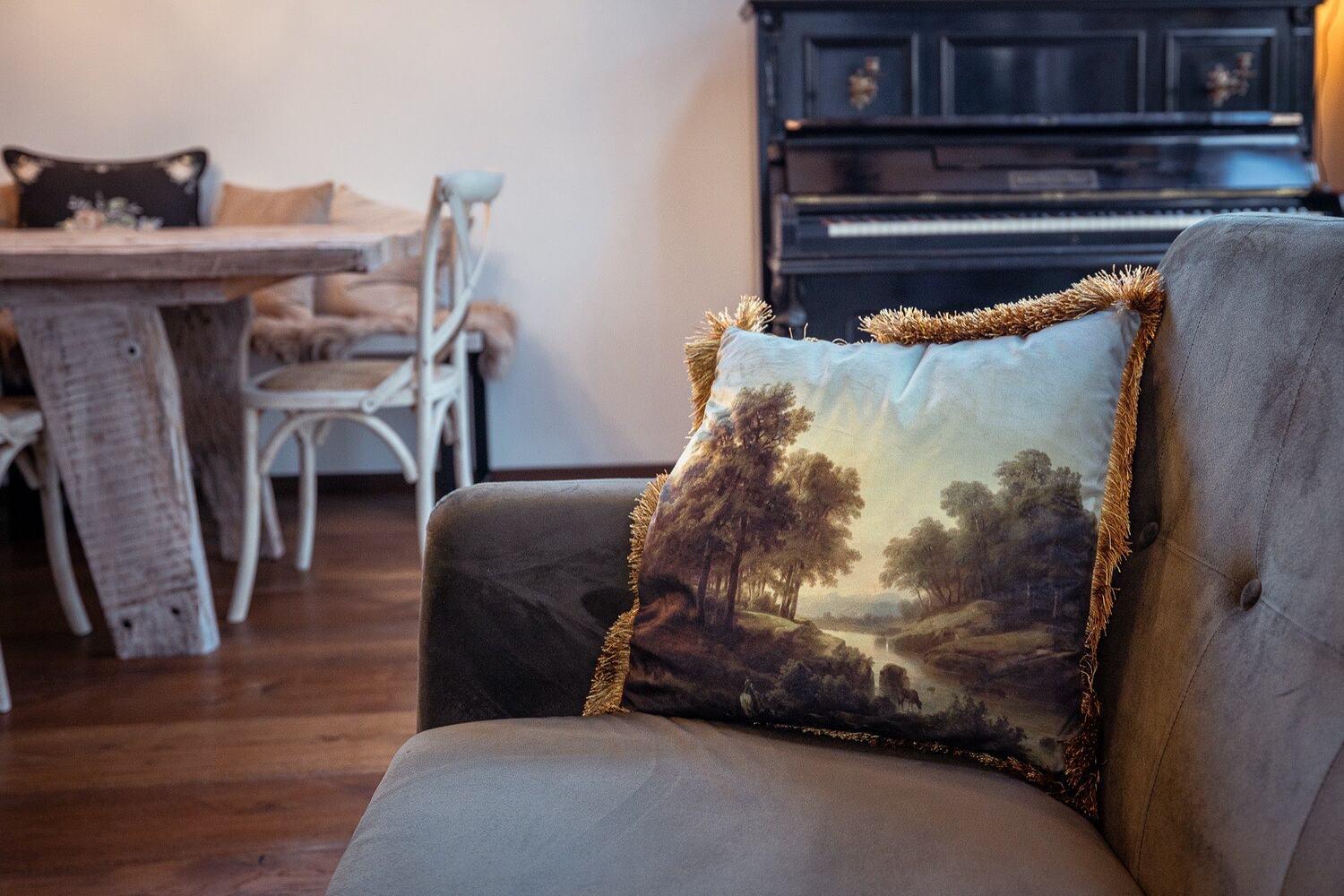
In the Johann apartment, an old wooden wardrobe sits next to a plain, contemporary desk. The combination wasn't curated the way a showroom would be - it grew out of what was already in the house and what a workspace needed.
Boutique Apartment Styria: What the Term Actually Means Here
"Boutique" is a word used so freely in hospitality that it now gets attached to hundred-room hotels with a single corporate look. At a boutique apartment in Styria like this one, the meaning is narrower and more honest: five units, none of them interchangeable, no central reception dictating the routine. Each apartment was thought through on its own, not as a variant of a base type. That shows in the scale, too: a house with five apartments can't be run like a hundred-room hotel, and that's the whole point. There are no standard processes stamped onto each apartment - instead there's a kind of care that can respond to five actual rooms, not to a metric.
The difference from a classic hotel shows up mostly in the details: there's no room-number logic where room 12 and room 34 are identical down to the bed linen. There are five names - Johann, Anna, Steiermark, Fuchs, Kaiserblick - and five apartments that actually live up to those names visually. Where the names come from can be read in the story behind the apartment names - they trace back to the story of Archduke Johann and Anna Plochl, whose connection to the region shapes the whole house, not just the name on the door.
Luxurious Vacation Apartment Styria - Without Marble Bathroom or Chandelier
Luxury is often equated with material cost: marble, gold, a chandelier in the entrance hall. A luxurious vacation apartment in Styria, as it's understood here, is defined differently - through time rather than fittings. The luxury lies in having a kitchen to yourself that you don't share with other guests. It lies in the door closing behind you and nobody knocking on it again. And it lies in the simple fact that a room is genuinely yours for the length of your stay, with everything that means for the shape of a day: a second breakfast at eleven, a book left lying on the sofa without it being tidied away by the next morning.
It still shows up in concrete places: full kitchens instead of kitchenettes, real seating instead of folding chairs, bathrooms planned for the specific apartment rather than pulled from a modular system. But the actual difference from a hotel suite isn't the list of fittings - it's the absence of a schedule imposed on you. Nobody knocks at nine for housekeeping, nobody asks at breakfast whether everything tasted alright.
Special Accommodation Styria: The View From the Kaiserblick Apartment
The view from the Kaiserblick apartment was the starting point for the entire interior: restrained colours, little that competes with what's outside the window. An example of how the furnishing here grew out of each individual apartment, not out of an overarching style concept.
Special Accommodation Styria: When the Building Itself Is Part of the Story
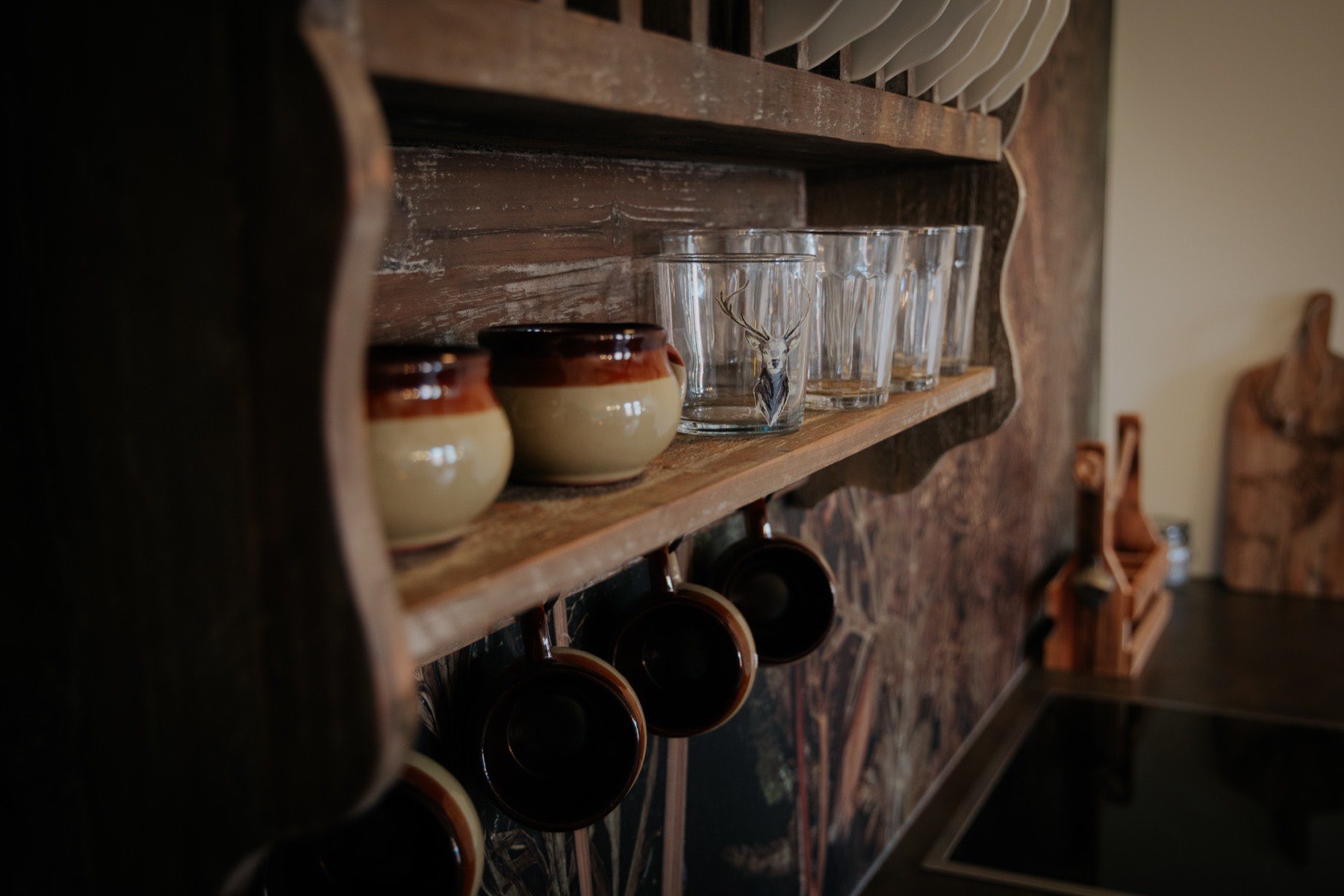
Special accommodation in Styria doesn't come from fittings alone, but from the history a building brings with it. The estate on the Stainzbach isn't a new build planned around a particular design. It's an old house that was converted into five residential units over the years - and that history is still legible: in the wooden beams, in ceiling heights that vary from room to room, in window formats that differ from apartment to apartment because they weren't installed new but come from the original fabric of the building. Anyone who has stayed in a new-build apartment with identical windows in every room notices the difference quickly: here, every room has its own proportions, because the building itself was never built to standard measurements.
The location reinforces this. The Stainzbach stream runs right past the garden, and the estate sits in the middle of the Schilcherland, surrounded by vineyards rather than a row of hotels. Anyone who wants to know more about the region itself can find that in the overview of the vacation apartment in West Styria, which covers the location, getting here, and the surroundings in detail. This page deliberately stays focused on the apartments themselves - on what sets a design apartment in Styria apart from an ordinary hotel room.
How Material Choices Differ From Apartment to Apartment
One detail that was deliberately never standardised during planning is the choice of materials and colours. In the Fuchs apartment, warm wood tones dominate, suited to the smaller floor area and making the room feel warmer than a cool, bright palette could. In the Anna apartment, it's lighter surfaces and more open wall space - matching that apartment's quieter position in the house. Steiermark, with its two bedrooms, can carry bolder accents, because the floor area is larger and leaves more room for contrast. None of these decisions were made in a single planning pass - they happened over years, apartment by apartment, often starting from a single piece of furniture that set the tone for the whole room.
That's also why it's worth comparing the five apartments before booking: anyone looking for a quiet, bright setting is better off in Anna than in Steiermark. Anyone needing room for a small group will find the more suitable floor plans in Johann or Steiermark. A look at the apartment overview with all five apartments in detail helps you make the right choice ahead of time, rather than leaving it to chance.
Who a Design Apartment in Styria Is Right For
Not every stay needs the same apartment, and the five are set up to be used differently. Anyone travelling alone or as a couple who values quiet will find the better fit in Anna or Kaiserblick. Anyone working remotely and needing a proper desk is best off in Johann, where the work area is permanently set up rather than improvised at the kitchen table. Families or small groups of four will find two separate bedrooms in Steiermark, which can be the difference between a relaxed stay and a cramped one. And anyone simply looking for a compact, warm apartment for a long weekend, without needing much space, usually ends up in Fuchs.
The common thread across all five: no reception desk, no fixed daily schedule, one key that belongs only to you for the length of your stay.
Which of the five apartments best suits your stay becomes clearest through a direct comparison.
View the design apartments in the apartment overview now - or ask a question about one of the five apartments directly.
What makes a design apartment in Styria different from an ordinary hotel room?
Mainly the individual furnishing: each of the five apartments at Johann & Anna was furnished separately, with different materials, floor plans, and colour choices - not as a variant of one room type repeated five times.
Are all five apartments furnished in the same style?
No, deliberately not. Johann, Anna, Steiermark, Fuchs, and Kaiserblick differ in material, colour, and floor plan - that's the central difference from a uniformly styled hotel concept.
Which apartment suits two people looking for quiet best?
Anna and Kaiserblick are particularly well suited to a quiet stay for two, with bright rooms and a view, respectively, that need little distraction from the furnishing itself.
Is there an apartment with its own work area for remote work?
Yes, the Johann apartment has its own permanently set up work area, separate from the living and sleeping areas.
Can I look at the five apartments in detail beforehand?
Yes, the apartment overview lets you compare all five apartments individually, with photos, floor plans, and amenities.
Why doesn't Johann & Anna have a uniform row of rooms like a hotel?
Because the house grew historically and was converted into five individual residential units, rather than built new with a fully planned room structure. That history is still visible in the varying ceiling heights, windows, and floor plans.